
Resilience In Bridges and Biology
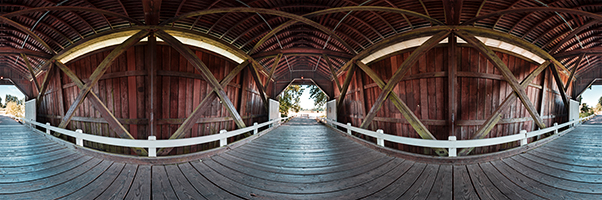
This is the Irish Bend Covered Bridge in Corvallis, Oregon. I photographed it for the World Wide Panorama (WWP) theme of “Resilience.” Though the bridge no longer sits in its original location and is no longer used for vehicle traffic, it remains a classic example of covered bridge architecture.
Covered bridges were designed with roofs not just for aesthetic reasons, but for durability. The roof protected the wooden structural elements from rain and sun, greatly extending the bridge’s lifespan. In this way, the covered bridge is a model of resilient design—its very form is a response to the need for longevity and endurance.
As I considered the theme of resilience in the context of this bridge, I found myself reflecting on how the concept applies to living organisms as well. In biological terms, resilience arises through evolution. Traits that improve an organism’s chances of survival and reproduction are naturally selected over time. This kind of resilience is driven by self-interest—by the organism’s internal programming to maximize its own success. Richard Dawkins famously described this dynamic in The Selfish Gene, which explores how even seemingly altruistic behaviors can be traced back to underlying genetic self-preservation (see Wikipedia for a good overview).
The bridge, on the other hand, did not become resilient through self-preserving instincts. Its resilience was designed into it by humans, not for the bridge’s own benefit, but so it could better serve its purpose—allowing people to cross the water safely for many years to come. In this sense, the bridge’s resilience reflects not selfishness, but service.
That contrast struck me: in organisms, resilience tends to emerge from self-focused pressures; in the case of the bridge, it was the result of an outward-focused intent—something more akin to love.
This may be pushing the metaphor, but the comparison is worth considering. If we, as living beings shaped by a process grounded in self-interest, are capable of designing something resilient out of love for others, then perhaps we are also capable of rising above our genetic programming. How can we hope to do that? How can we find ways to build lives and societies that reflect this other kind of resilience—one rooted not in self-preservation, but in care?